How to Organize Your Kitchen When It Feels Like You Don’t Have Enough Storage
Does your kitchen always feel too small? I've had 4 kitchens in my married life. All 4 have been different sizes and what I thought was an upgrade to the one before. But sure enough shortly after setting up each kitchen I end up deciding that I don't have enough space. But how can that be? Each kitchen is decidedly bigger and my family size has stayed the same. So what is the real issue?
My issue hasn't been the kitchen being too small but instead it's been how I've organized the kitchen space.
The answer isn't necessarily finding more places to put things but learning to use the kitchen space more intentionally.
So let's go through the kitchen and see if we can't make it more organized, calmer, and easier to use.
1. Start with “How Do I Use My Kitchen?”
Before thinking about all the cute kitchen organizers you could buy you need to take stock of the actual needs of your particular kitchen and how it is used.
Your kitchen needs to support how you actually live life not any other family but yours.
At the current writing of this article our kitchen needs to support 4 adults. 2 working at home , 1 working outside the home, and one retired but busies than the rest. It needs to support a food allergy, healthy eating, and a desire to cook most foods from scratch. And it also serves 4 cooks. All the adults cook in this household.
Ask these questions:
- What do we cook most often?
- What do items do we reach for every day?
- Which appliances are used regularly (like weekly)?
- What takes up valuable counter or kitchen space but actually rarely gets used?
- Which areas are a frustation?
- What always ends up on the counter no matter how many times you put it away?
The answers to these questions will give you a cleared idea about how to organize your particular kitchen .
Let's answer these questions for my kitchen so you can have an idea of how to answer the for your kitchen.
- We all eat separate breakfasts but make a lot of tea and coffee. We cook a family dinner every night of the week. We have baking spurts a few times a month. And we do a lot of freezer meals, and prepping garden or surplus food for the freezer.
- Every day we reach for mugs, tea and coffee, something for lunch, and dinner prep and tableware.
- The stove top, water boiler, and coffee pot is used daily. The oven is used several times a week. The counter air fryer is used several times a week and sometimes daily.
- Taking up counter space but not used as much is a milk frother, coffee percolator, coffee grinder, and turkish tea pot.
- What always ends up on the counter even though it's constantly moved is mail (still figuring that out) and cutting boards.
After asking these questions it's time to walk around your kitchen and pick one particular area to organize.
You won't solve all your kitchen issues in one day.
We're just choosing one area of frustration and dealing with it.
2. Make Sure Everything Has a Home
A place for everything, everything in its place. ~Benajmin Franklin
In your home everything should have it's own place.
If something doesn't have a home, it will eventually end up just living in places like on the counter or in spots that cause you frustration.
And these items with no homes can cause clutter which can make the entire room, such as your kitchen, feel smaller.
In addition to my own list think about the things that regularly get left out on kitchen counter:
- Water bottles
- Grocery bags
- Cooking utensils
- Small appliances
- Paper towels
- Food containers
Instead of constantly putting them away (while being frustrated about it), ask:
“Where could this item live so putting it away is intuitive and easy?”
The best home for an item isn't necessarily the latest storage solution you spotted on Instagram or Pinterest. It might even be something you never thought of.
It will be the place that makes sense for your family and home.
For example if mail is continually being left out on the kitchen counter maybe you need create a spot on the kitchen counter for collecting mail.
I know, I know. Get over it and find the best organizing solution for that countertop mail.
Do this for each frustrating section in the area you are working on.
3. Keep the Things You Use Most in an Easy to Reach Area
In a small kitchen storage space is valuable real estate so you'll want to organize your things according to use.
Everyday Items
These are the items within easy reach. Think; when you get up groggy in the morning or after a mad dash home:
- Coffee and/or tea supplies
- Frequently used pots and pans
- Daily cooking utensils
- Everyday dishes
- Basic food staples
Weekly
These can go slightly farther away.
- Baking dishes
- Kitchen cleaning supplies
- Meal prep items
Occasional/Hosting
Store these less used items in harder-to-reach cabinets, higher shelves, or even in surplus storage elsewhere in your home.
- Serving dishes
- Hosting dinnerware
- Teapots
- Punch bowl
Seasonal or Holiday Items
These are the kinds of items you can store outside of your kitchen. No need to take up that prime real estate.
Think of your kitchen for everyday life not for the occasional dinner or holiday party.
- Cookie baking supplies
- Themed dishware
4. Go Up
When countertop or cabinet space is hard to come by then thing vertical.
Any trip to ikea and you will realize how much you can do with the vertical space in your kitchen.
Think about:
- Shelf risers – double your cabinet space.
- Wall-mounted hooks – hang dish cloths, brushes
- Magnetic storage – for things like knives
- Hanging rails – these can be so cute and hold any matter of items. Your paper towels, a small cup for utensils, etc.
- Over-the-door organizers – this can really maximize your space. You can store spices or other pantry staples.
- Tall narrow shelves in tight spaces can help you store items. Secure them to the wall.
But don't overdo it.
While it may be tempting after thinking about all those cool things you can add to your walls, covering every wall in your kitchen can result in a kitchen that feels crowded.
Instead, choose one or two vertical solutions that solves an actual issue in your kitchen.
5. Store Like Items Things Together
Putting like items together in your kitchen makes it easier to navigate.
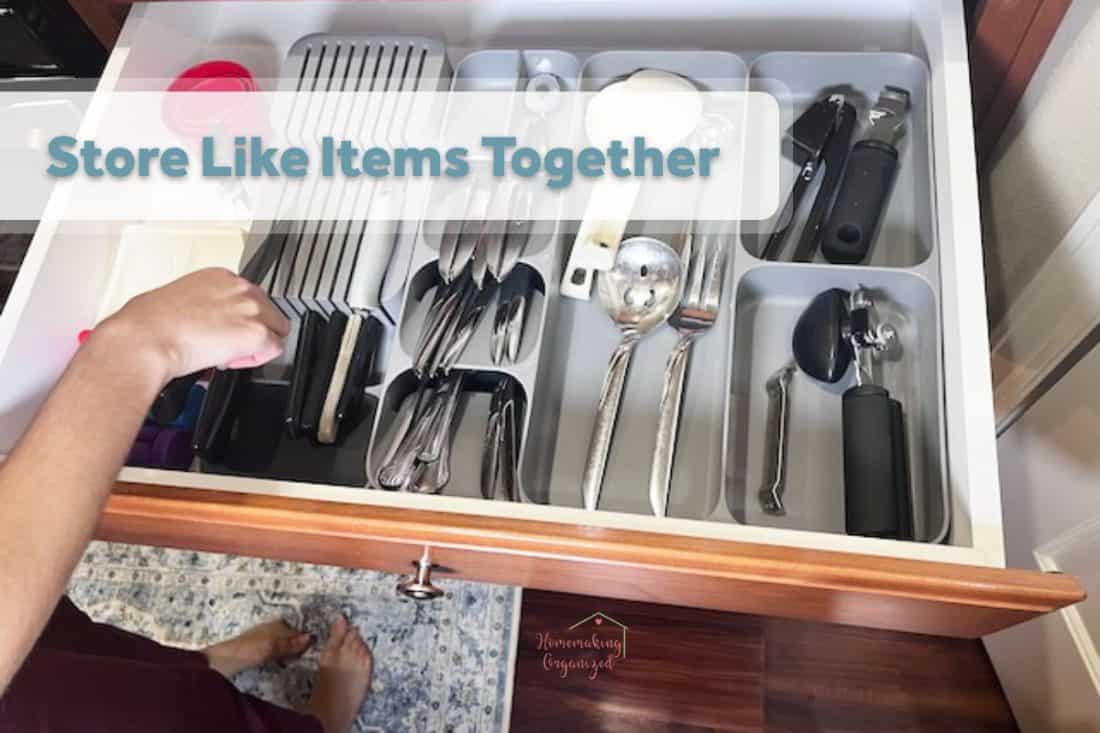
Here are some example stations:
Baking Station
- Flour
- Sugar
- Baking powder
- Measuring cups
- Mixing bowls
Coffee & Tea
- Coffee and Tea
- Coffee Pot
- Filters
- Sweeteners
- Mugs
Cooking Station
- Spices
- Cooking oils
- Utensils
- Pots and pans
Food Storage
- Containers
- Lids
- Reusable bags
- Foil
- Plastic wrap
When everything has it's own space, you're less likely to search through five cabinets to find one item.
6. Find “Homes” for Small Items
Small kitchens can become overwhelmed by tiny things.
Such as:
- Measuring spoons
- Chip clips
- Straws
- Vegetable peelers
- Kitchen gadgets
- Food storage lids
- Garbage bags
Give each category one home. Don't have things all over the place in the kitchen.
For example:
All food storage lids live here.
All measuring tools live here.
All storage bags live here.
When the category's space is full, that's your sign that you have enough. If you find something else you need to add to the category then maybe something else needs to leave.
This prevents small items from being all over the place in the kitchen.
7. Keep Your Countertops Clear
Please don't get into the idea that you need completely clear countertops.
You want your kitchen to look like someone lives there. Not a messy person but a real person. This isn't a photoshoot.
If your kitchen seems small, every item left on the counter can make it seem that much smaller.
Let's divide those countertop items into three categories:
Used Every Day
- Coffee maker
- Toaster
- Utensil holder
Used Several Times a Week
Consider putting these away if you have space.
- Blender
- Cutting boards
- Instant Pot
- Sheet Pans
Used Occasionally
Definitely consider storing these.
- Mandoline
- Vacuum Sealer
- Ice Cream Maker
Your goal isn't an empty counter but a counter that works for you.
8. Create a “Landing Zone” in the Kitchen
Kitchens often become the dumping ground for everything that comes through the front door.
- Keys.
- Receipts
- School papers
- Shopping bags
- Random objects that belong somewhere else
Does this sound like your kitchen? You may need a landing zone.
A landing zone doesn't have to be large. You just want to place it near the kitchen.
A n idea is a small basket or designated spot near the entrance to the kitchen.
Teach the family the rule:
Things waiting to be dealt with get placed in their designated landing spot instead.
9. Use Containers Carefully not Creatively
We all love containers.
They look so beautiful when they are all matchy and lined up together full of kitchen foodstuffs.
But decanting everything brings about it's own set of issues..
Try to decant into containers only when they solve a specific problem:
- Something is difficult to store in its original packaging.
- You need to see how much you have.
- Items are difficult to stack.
- A container makes everyday use easier.
Don't buy a container simply because it looks beautiful (or you saw it on social media).
I admit it. When people started showing these fabulous decanted pantries on social media I gave it a try. And quickly discovered it's more of a pain than a help.
- Containers can be costly if you need a lot of them.
- I cook a lot of different types of cuisines. And because of that I have so many specialty ingredients in my pantry decanting didn't make sense.
- What do you do with what's left in the original packaging if your decanting container is full.
Organization should improve function first. If it's cute that's a bonus but shouldn't be the deciding factor.
10. Store Things Near Where You Use Them
It sounds like a no brainer but you would be surprised how often we don't keep things near to where we use them when it comes to kitchen organization.
Where you make your coffee store the coffee supplies there.
If you bake once a month, don't give your baking supplies prime real estate but organize them together in another part of the kitchen.
Think about how you move through the kitchen.
Reduce unnecessary steps.
A well organized kitchen should feel almost intuitive. For those who cook there.
14. Create a Small-Kitchen “One in, One out” Rule
This is one of the most useful habits you can establish in your kitchen and honestly your whole home.
Your kitchen can only hold so much.
If your cabinets are full, it may mean something needs to leave.
Some examples:
New coffee mug in→ old mug you don't use leaves.
New food storage container in→ get rid of damaged or unused container.
New kitchen gadget in→ it's time to edit all the kitchen gadgets and see if one can leave.
We're not going for minimalism here (unless that is your style).
We are going for useful and uncluttered.
What If Your Kitchen Still Feels Too Small after all this Organizing?
Sometimes, despite all of your efforts, it turns out your kitchen really is small.
That's okay. We're not trying to make it look big. We are trying to use if efficiently
Some other things you may do:
- Edit your small appliances and keep fewer. Replace with multi-use appliances if you are able.
- Store seasonal or rarely used items in other parts of your home
- Store bulk storage in another room
- Shop more frequently instead of storing large quantities
- Choose smaller versions of frequently used items
- Give away or donate duplicate tools
A small kitchen often requires more intentional choices, not necessarily more organization products.
A Simple Small-Kitchen Challenge
Don't try to reorganize your entire kitchen in a weekend. Instead do this 7 Day Small Kitchen Challenge to get things in order.
More Kitchen Cleaning and Organizing
Cleaning and Reorganizing the Pantry
Cook Faster By Being More Organized
Ready to move to the next level? Read this post at NestSpirations about DIYing a small kitchen.
2 Comments
Comments are closed.